
Meeting ISO 14001:2026: Utilising Cobots for Automating Sustainability
Environmental compliance has officially shifted from a corporate social responsibility tickbox to a core operational constraint. With the recent June 2026 changes to the ISO 14001:2026 environmental management standards, manufacturers and industrial facilities find themselves under a microscope. Businesses now face a strict transition window to adapt to requirements around resource optimisation, empirical data tracking, and structured change management.
For operations managers, the immediate worry is overhead. Stricter tracking rules regarding waste, energy, and supply chain oversight can easily impact production lines with paperwork, manual checks, and administrative friction.
But there is a silver lining that bridges the gap between compliance and profitability: collaborative robots.
Far from being mere tools for increasing throughput, cobots are uniquely suited to meet the modern demands of green auditing. By marrying sub-millimeter precision with native data-logging capabilities, collaborative automation allows manufacturers to hit their sustainability targets without sacrificing production speed.
The Core Challenges of ISO 14001:2026
The latest iteration of ISO 14001 steps away from generalised environmental intent and focuses heavily on demonstrable performance. Auditors are looking less at written policies and more at your real-world telemetry.
Specifically, the 2026 updates put three critical areas under a microscope: minimising material waste and scrap, documenting changes to production workflows, and providing objective data logs to prove environmental targets are being met.
Achieving compliance with ISO 14001:2026 doesn't have to mean slowing down your throughput or drowning in regulatory red tape. By capitalising on the precision, adaptability, and data accuracy of collaborative robots, you can turn these regulatory hurdles into a competitive, sustainable advantage.
Clamping Down on Scrap (Clause 4 and 5)
The most direct way factories and machine shops impact their environmental footprint is through physical waste. Traditional manual tasks like gluing, dispensing, or welding are notorious for human error. A slight slip of the hand, a momentary distraction, or variance in operator techniques results in a defective part. In an era of strict lifecycle assessments, every scrapped part represents wasted raw materials, squandered energy, and a higher carbon footprint per unit shipped.
Cobots eliminate this variance. When programmed for an application, a cobot delivers the exact same pressure or applies the exact same volume along the exact same path, every single time.
By reducing defect rates to near-zero, you fundamentally minimise your facility’s material scrap rate. When an ISO auditor reviews your waste-reduction initiatives, you can point directly to a cobot cell as an active, preventative control that systematically optimises resource consumption.
Navigating the New Change Management Rules (Clause 6.3)
One of the most consequential updates to the standard is the introduction of Clause 6.3 (Planning of Changes). Under this new mandate, when a business updates an operational process to improve its environmental standing - such as switching to a lighter, bio-based plastic or a less energy-intensive curing method - the transition cannot be done ad hoc. It must be executed via a structured, documented change management process.
Historically, documenting a process change meant halting production to rewrite standard operating procedures (SOP), conducting extensive retraining sessions, and keeping manual logs of the rollout.
With the integration of cobots, change management is inherently digitised through:
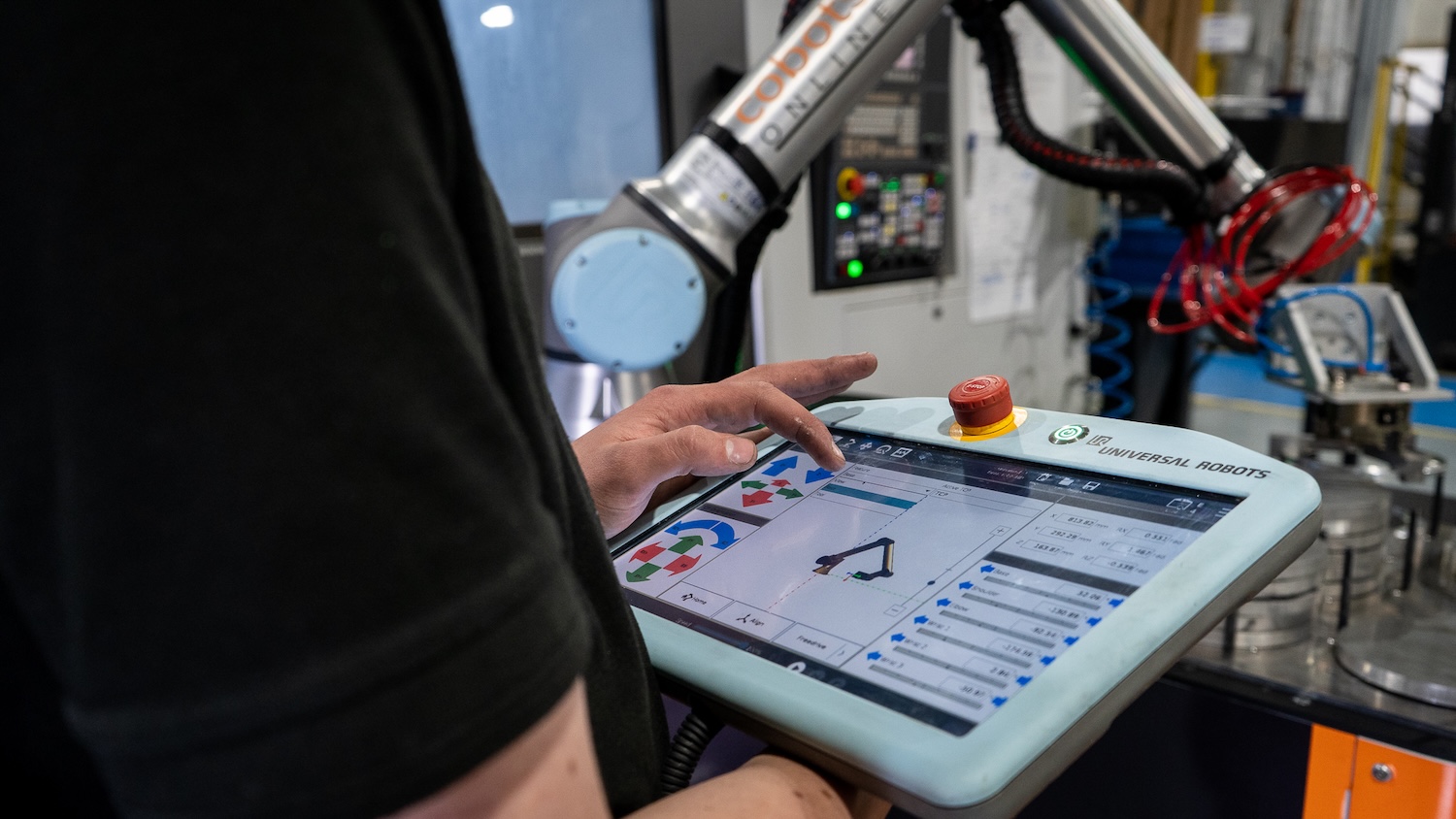
- Software-Defined Adjustments: Modifying a task to account for a new, greener material is as simple as tweaking a few lines of code or adjusting coordinates on a teach pendant.
- Version Control: Because cobot software operates on digital files, updates can be saved, timestamped, and catalogued.
- Instant Standardisation: Once the new program is verified on one cobot, it can be deployed instantly across an entire fleet via a USB or local network, guaranteeing that the change is applied identically across the floor.
The digital footprint provides an airtight paper trail for auditors, turning a complex administrative requirement into a routine software update.
Audit-Ready Telemetry (Clause 9)
The phrase that strikes fear into the heart of any compliance offer is: “Prove it”. Under Clause 9 of ISO 14001:2026, enhanced performance means you must back up your environmental achievements with hard data. If you claim your operations reduced its carbon intensity by 5% this quarter, you need the evidence to support it.
For manual lines, gathering this data requires a complicated mix of utility bills, guestimated floor hours, and manual clipboard tallies. Cobots, however, are fundamentally IoT-enabled data engines.
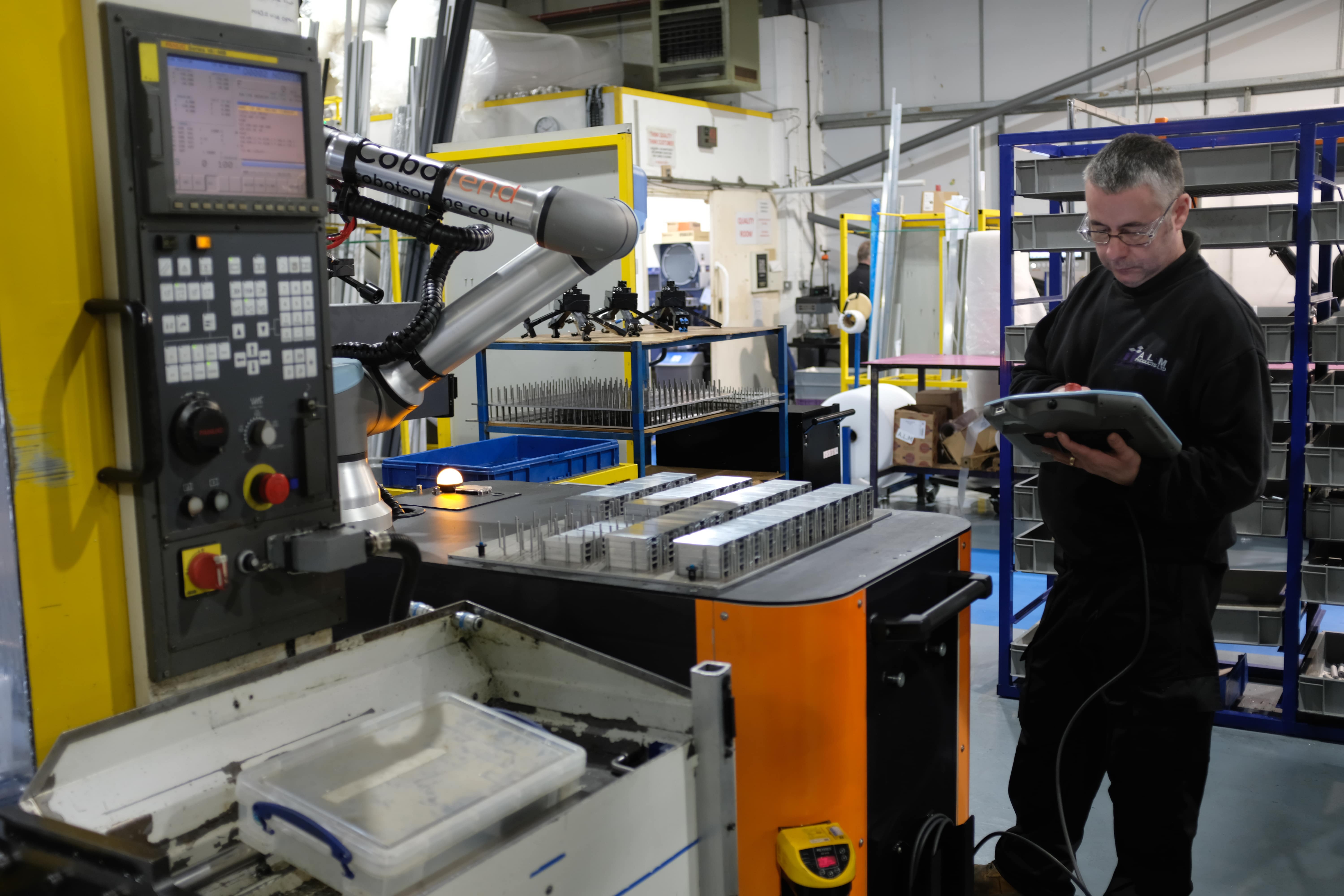
Because cobots constantly monitor their own current draw, cycle times, and throughput metrics, they provide granular control over your operational data. You can calculate the exact kilowatt-hour cost of a single unit production, track precisely how much raw material was consumed over a week, and flag exactly when a tool began to wear out before it caused a batch of bad parts.
Your environmental team no longer has to guess or extrapolate, they can pull automated reports straight from the automation dashboard to present to external auditors.
The Supply Chain Ripple Effect (Clause 8)
It is also worth noting that the 2026 updates place a close focus over your broader value chain. Clause 8 shifts its language to look closely at “externally provided processes, products, and services.” Manufacturers are now being forced to vet the environmental practices of their supplies to protect their own certificates.
If your facility acts as a supplier or a tier-2 manufacturer, your compliance status is a significant competitive differentiator. By implementing cobots to drive down your internal waste, reduce energy consumption, and guarantee ISO alignment, you become an incredibly safe, low-risk partner for major enterprises trying to clean up their own scope 3 emissions.
Future-Proof Your Operations Today
The common misconception is that automation and green compliance are competing priorities - one focused on speed, the other on restraint. ISO 14001:2026 proves that the two are now deeply intertwined.
As the three-year transition window for the new standard begins to tick down, updating your floor with flexible automation isn’t just an upgrade for productivity, it’s a proactive strategy for future-proofing your entire environmental management system.
You don’t have to navigate the transition alone. As the UK’s leading provider of collaborative robot solutions, Cobots Online is dedicated to helping manufacturers and SMEs deploy smart automation with zero stress and disruption.
Our expert team handles the entire process end-to-end, from initial design and integration to training and ongoing support. Whether you need to tighten up raw material usage or build a highly repeatable production environment, we offer targeted, turnkey solutions to make your transition effortless. Through live demonstrations, we can show you exactly how our systems operate, how easily your staff can be trained to program them, and how quickly your green investment will pay for itself.
Contact Cobots Online’s automation experts today and let’s build a smarter, cleaner, and more resilient manufacturing future.