
Automation Without Moving Factory: Fitting Cobots Into Small Footprints
Picture a twelve-person machine shop. The CNC is busy, the order book is full, and finding skilled operators gets harder every year. The owner has looked at automation more than once. Each time, the same thought stops the conversation: we’d have nowhere to put it.
Every square inch is already spoken for. Raw material on one side, finished parts on the other, a walkway the team actually needs. Automation, as the owner pictures it, means robot behind a big fence, and a big fence means a bigger building.
But what if the robot was never the problem? For many small manufacturers, the real constraint is the space around the robot. And that is exactly the part collaborative robots are designed to change.
The Real Cost of Space
When people price an automation project, they usually start with the robot arm. It’s the visible part, and it’s the number on the quote.
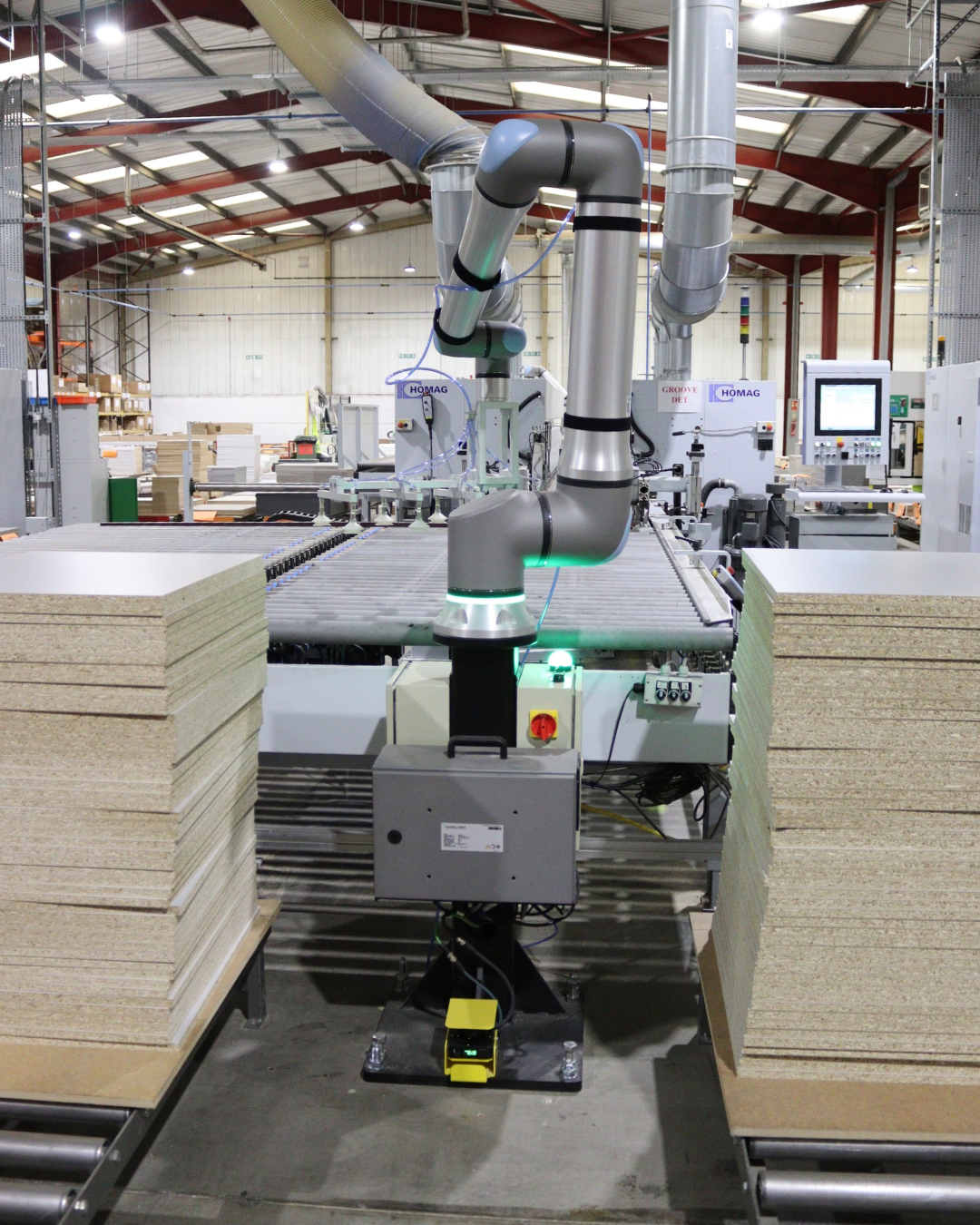
But a traditional industrial robot can’t simply be placed on the shop floor and switched on. Its speed and reach make it hazardous to anyone nearby, so it is normally enclosed. That means perimeter fencing, access gates, safety interlocks, light curtains or other presence-sensing devices, and a clearance zone around the whole cell. Add the space needed to get materials in and out, and the footprint grows well beyond the robot itself.
For a large plant with room to spare, that’s a planning exercise. For an SME, it can be a deal-breaker. There’s rarely a spare corner, and the alternatives of reorganising the shop floor, extending the building, or leasing new premises, are far bigger decisions than buying a robot.
So the question many owners ask is “can we afford a robot?” The more useful question is “can we afford the space around it?”
This is where the collaborative robot changes the equation. A cobot is built to work near people, so the heavy guarding that drives the footprint of a traditional cell isn’t automatically part of the picture. And when the cobot is mounted on a mobile base, like our machine tending solution CoboTend, the footprint becomes something you can move rather than something you permanently give up.
The traditional approach has always been, a robot sits beside the machine, enclosed by fencing. There's a gate for access, interlocks that shut the robot down when the gate opens, and a defined clearance zone around the perimeter. The cell is fixed. Moving it means dismantling it, and reaching the machine for a manual job can mean switching the whole cell off.
The cobot approach works at the same machine, with a much smaller defined working area. The operator can still reach the machine directly when they need to run a one-off job or make an adjustment.
How Cobots Work Safely Without Barriers
“No cage” is the phrase that makes experienced engineers nervous, and rightly so. It’s work being clean about what it does and doesn’t mean.
It does not mean there is no safety work. It means the robot is designed so that, in the right application, people can work in its vicinity without a fixed physical barrier between them. Robot safety standards, including ISO 10218, describe four ways of achieving this:
- Safety-Rated Monitored Stop: The cobot stops when a person enters its workspace and can resume when they leave. Think of it as a pause button that presses itself.
- Hand Guiding: The operator physically moves the arm to teach it a position or path, which is a big part of why cobots are quick to programme.
- Speed and Separation Monitoring: The cobot slows down as a person gets closer and stops if they come too close, then speeds back up as they move away.
- Power and Force Limiting: The cobot is designed so that if it does make contact with a person, the forces involved stay within acceptable limits.
These are the principles that make it possible to work alongside a cobot rather than behind a fence from it.
The Cobot Is Not the Application
Here is the point that matters most, and the one that’s most often misunderstood: a collaborative robot does not automatically make a collaborative application.
The risk comes from the whole system. A gripper with sharp edges, a hot workpiece, a heavy or awkwardly shaped part, or a fast movement can each turn a gentle cobot into a hazard. This is why every installation needs a proper risk assessment, looking at the cobot, the tooling, the parts and the task together, and at how people will actually behave around it.
This is also why we treat the assessment as the start of the conversation rather than a box to tick at the end. When we plan a CoboTend installation, Cobots Online’s automation team looks at your parts, your machines and your shop floor first, and design the cell around what the assessment shows. CoboTend is integrated with sensors, part trays and safety features, and we’ll work through with you how those apply to your specific application.
Integrating Cobots: Mounting and Practical Planning
Once you know a cobot suits your application, the next question is how to fit it into the space you have. And there are surprisingly more options that most people expect:
- Pedestal or Bench: A cobot on a stand at a workstation, for tasks like assembly, screwdriving or inspection.
- Fixed Beside a Machine: A dedicated cobot serving one machine.
- Wall or Overhead: Lifting a cobot off the floor to free up the workspace below.
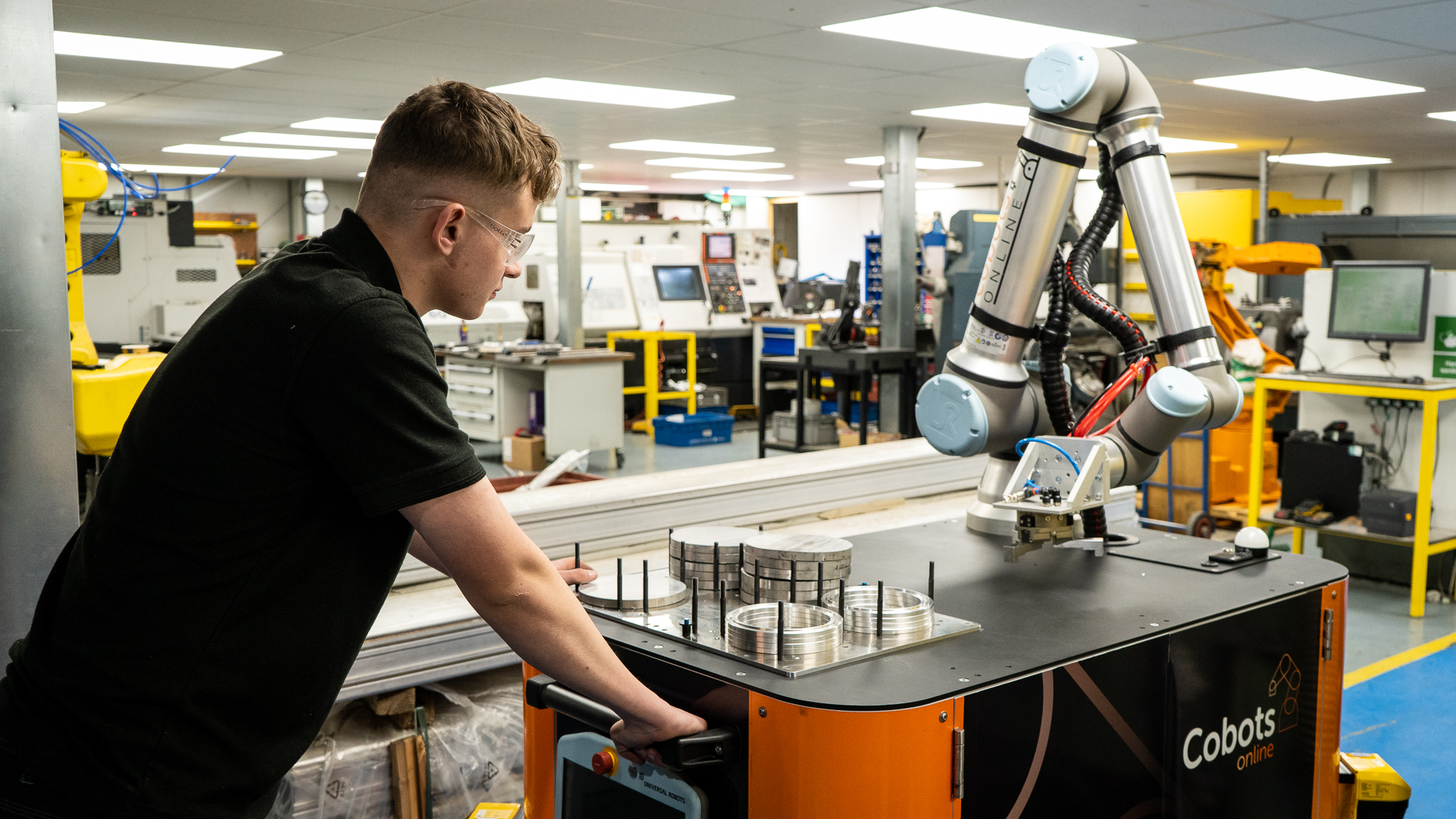
- Mobile Base: A cobot on a wheeled unit that moves where the work is.
The mobile option is where the footprint argument is the strongest. A fixed installation claims its space permanently. A mobile unit claims it only while it’s working.
CoboTend was developed with high-mix, low-volume manufacturers in mind, where the job on the machine changes often and one cobot may need to serve several machines. It is a self-contained mobile cobot unit, compact and easy to manoeuvre, quick to deploy and even quicker to relocate. It’s compatible with a wide range of CNC machines, and is designed to be easy to program and simple to customise. Instead of dedicating a robot and a patch of floor to every machine, one unit can tend whichever machine needs it, and be moved quickly onto the next when the need arises for maximum efficiency.
There’s an added benefit for businesses chasing more productive hours. A cobot loading and unloading parts can keep spindles turning throughout breaks, late shifts and weekends, with minimal intervention. One of collaborative robots greatest advantages is the ability to introduce lights-out machining without a bigger factory floor.
Cobots generally trade some speed, reach and payload for their flexibility and safety profile. For many SME applications, that trade is entirely worth it, especially where the alternative is no automation at all. But check that the specifications match your parts before your commit. At Cobots Online, we’ll tell you honestly if they don’t.
Integrating Cobots in Small Footprints
Automation doesn’t have to mean a bigger building, a fenced-off corner or a major rebuild of your shop floor. For many small manufacturers, it can mean one automation solution, a sensible risk assessment and a plan that fits the space you already have.
As a Universal Robots Certified System Integrator, with a long history in manufacturing ourselves, we understand the pressures and challenges UK manufacturers face. Cobots Online is here to work with you, from identifying the right opportunities through to integration and aftercare, to ensure your collaborative robot is optimised and delivering ROI from day one.
Ready to see how it could fit into your factory? Explore CoboTend and get in touch with our automation team for a layout conversation.